
You automated your work. Your mediocrity too.

The problem isn’t AI
You’ve been using Claude, Cursor, ChatGPT, or any AI assistant for months. You’re supposed to be more productive. But if you’re honest with yourself, some days you end up more tired than when you did everything manually.
The reason? It’s not the AI. It’s you and those 15+ seconds of waiting.
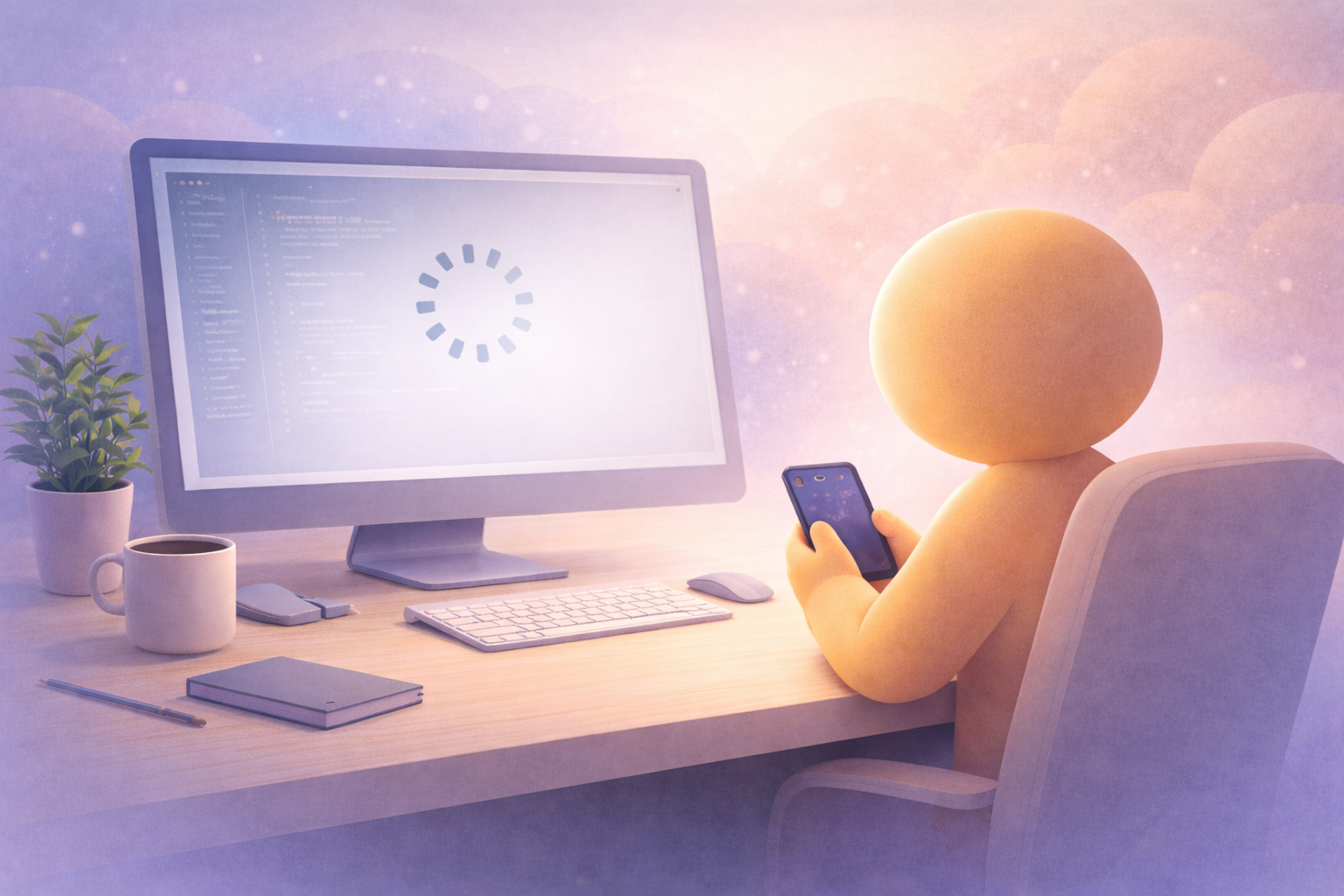
Every time you write a prompt and see “Generating…”, your brain interprets that as permission to disconnect. And like any good dopamine addict of the 21st century, you do what comes naturally: you open LinkedIn to see who posted what. You check X in case there’s something interesting. You scroll Instagram “just for a second.” It’s only 10 seconds, what could happen?
A lot, it turns out.
The 15-second trap
There are three types of waiting when you work:
- Less than 1 second: your brain doesn’t even notice. Everything flows.
- More than 5 minutes: enough for a real break. You grab coffee, stretch your legs, come back fresh.
- Between 5 and 30 seconds: the danger zone. Too little time to do anything useful, but enough for your brain to seek quick entertainment.
And here’s the problem: AI tools live right in that danger zone. They’re fast enough that you can’t justify a break, but slow enough that your finger moves on its own toward another tab.
What’s really happening
When you switch context in those micro-moments, you don’t just lose time. You lose something more important: your ability to think critically about what the AI just generated.
Has it ever happened that you accept a response without reviewing it properly, just because “getting back into focus” feels like too much effort?
When your mind wanders off to check LinkedIn posts for even 10 seconds, getting back to your work requires reloading all the context into your head. And since that’s cognitively expensive, your brain takes a shortcut: “Looks good, works, next.”
The result: work that “seems fine” but you don’t fully understand. And when something fails or your boss asks why you made that decision, you’ll remember this article.
The experiment that proves it all
A developer shared that during his vacation, he was coding on his personal laptop. Every time the AI started generating code, his hand automatically moved toward the keyboard shortcut to open the browser and check social media.
His brain kept executing the same pattern as always, even though there was nothing to check. It was pure reflex.
The urge to get distracted wasn’t a real need. It was a habit burned into his muscle memory.
The solution is boring (but it works)
There’s no revolutionary hack here. The solution is almost insultingly simple:
When the AI is generating, just keep watching.
Yes, that simple. That uncomfortable.
Some ideas for those 15 seconds:
- Read the AI’s thought process as it generates. Many models show you their reasoning in real time.
- Think about your next step. What will you ask next? What will you do with that response?
- Review what it already generated in the previous iteration while the new one processes.
- Just breathe. 15 seconds of doing nothing won’t kill you, even if your brain insists it will.
Concrete actions
If you made it this far looking for something practical, here are a few:
- Take your hands off the keyboard when you write a prompt. Literally. This breaks the muscle reflex to switch tabs.
- If the AI task is going to take more than 5 minutes, then yes, you can do something else. But choose intentionally what. Reading documentation is valid. Infinite scrolling through the feed is not.
- Accept the momentary boredom. Those 15 seconds of “doing nothing” are when your brain processes what’s happening. They’re not wasted time.
The point of all this
AI is an incredible tool. But its value is lost if you use it on autopilot while your attention is somewhere else.
The professionals who will stand out in the coming years won’t necessarily be those who write the best prompts. They’ll be the ones who can maintain focus long enough to truly understand and leverage what the AI is producing.
Productivity isn’t measured in completed tasks. It’s measured in solved problems. And to solve complex problems, you need something AI can’t give you: sustained attention.
So the next time you see “Generating…”, stay there. Your future self will thank you.
Did you relate to any of this? You probably opened another tab at least once while reading this. Don’t worry, I did too while writing it.
No spam, no sharing to third party. Only you and me.
Member discussion